One Rulebook to Rule Them All: Sport Karate's Path Forward

- Derek Beckman

- 2 days ago
- 3 min read

I have been having an ongoing conversation with a former student who has now become a colleague and collaborator. This conversation revolves around sport martial arts and its future. We both love the sport of karate and want to see it grow. Naturally, we both have ideas on how to make the sport better.
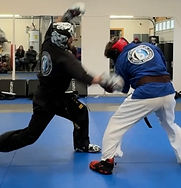
For those of you unfamiliar with sport karate, the best analogy I can offer is that it operates similarly to a gymnastics or track and field meet largely focused on individuals competing in various events, with some team aspects involved. While there are divisions that are fighting-focused, most bouts are light contact with an emphasis on control and technique rather than just beating each other's brains out. Kata performances tend to make up the bulk of most sport karate events. These can range from traditional demonstrations to more extreme trick-focused routines and weapons forms. My personal favorite is breaking, where we get to showcase our best strikes on boards and bricks the materials being the ultimate judge of how good we really are.
During our chats, we have come to the conclusion that sport martial arts not only has a marketing problem, but also a rules-comprehension problem for folks unfamiliar with how things work. On top of that, martial arts has in my opinion, a unity problem, and that is probably the most glaring issue of all.
Combat sports encompasses so many different types of martial arts, from Taekwondo to Jiu-Jitsu, with each methodology focused on different tactics and techniques that make each style distinct from the others. Each of these methodologies has its own governing body, with some sports like Judo and Taekwondo being featured in the Olympics. Karate got a shot at the 2020 Olympics in Japan but failed to make the cut as a permanent event. Sport karate has tried to combat the unity issue by making tournaments open to all comers, but some practitioners feel that this waters down their art and refuse to participate.
This is not a new problem. Jet Li even made a movie about an attempt to unify all the styles of wushu under one banner, in order to grow and preserve the sport as western influences encroached on China. If you have never seen Fearless, I highly recommend it.
So can sport karate grow? Is it even worth attempting the insurmountable task of bringing sport martial arts to more people? The market and tournament promoters would say yes. We don't even need one central league. What we really need is a set of agreed-upon rules that competitors and spectators can rely on from event to event. Any competitor should be able to travel from California to Florida and know the rules especially for sparring and extreme kata events. I understand that rule variations are often designed to keep competitors coming back to the same events time and time again, but even small deviations make the sport confusing and act as a barrier. Too often, they keep the best competitors relegated to obscurity, or give people reason to doubt their success simply because the rule sets are just different enough to say, "Oh, well they did it their way, not our way."
Deep down, many of us know that standardization is what needs to happen. Think about how the sport could explode if spectators understood the rules no matter what event they were watching if they trusted the judging from event to event. We could even have a Super Bowl of sorts, with all the leagues coming together at the end of the year to truly show who the cream of the crop is. It's a straightforward fix, y'all. Let's get it done.


Comments