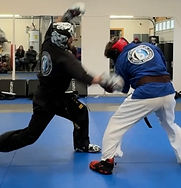
Empty Hands: The Most Powerful Weapon You Already Have
- Derek Beckman

- 7 days ago
- 4 min read

"I come to you with only Karate. My empty hands — I have no weapons. But should I be forced to defend myself, my values, or my honor, then here are my weapons. Karate. My empty hands."
These are the words my instructor passes along to every black belt he has ever trained — spoken after each student successfully completes their exam. And I'll be honest: I had forgotten them, until recently.
I had the honor of attending a fourth-degree black belt exam for a colleague, and those words came rushing back. Hearing them again, I realized they carry far more weight than I had originally given them. That weight deepens even further when you consider who is speaking them — a first-generation Cuban immigrant who understands, on a level most of us never will, what it truly means to stand unarmed in the face of power.
What Is Noble About Fighting Without Weapons?
The idea of facing the world with empty hands is layered with meaning. At its most basic level, it implies that you have a choice — that you have time to deliberate, that you are not acting out of pure reflex or fear. More often than not, it also means you are at a disadvantage. You are the underdog.
That's not coincidence. Martial arts were forged by oppressed communities who were forbidden from carrying weapons — precisely because those in power feared what would happen if they could defend themselves. Spoiler: they revolted anyway.
That history matters. It's woven into the fabric of every kata, every drill, every lesson passed down from instructor to student.
The Most Available Weapon: Your Voice
I've spent a lot of time since that exam thinking about how the philosophy of empty-hand fighting extends far beyond the dojo — and how it applies not just to martial artists, but to everyone.
Not all of us train. Not all of us will ever throw a punch in self-defense. I only recently purchased my first firearm, and while I have no delusions about my abilities, thirty-plus years of practice means I would hold my own in a physical confrontation if it truly came to that. But that's beside the point.
The point is this: speech is the single most available and powerful form of weaponless fighting we have.
America has always held free speech sacred — so much so that it was enshrined as the very first amendment to our Constitution. And there is a reason it is always the first thing those in power seek to control.
Athletes, Platforms, and the Right to Speak
I bring this up as someone who has wrestled with it personally.
I competed in Germany last year representing the United States, and I'm preparing to represent the US again in France later this year. As an athlete who wears the flag, I've had to sit with some uncomfortable questions — especially as debates swirl around what it means to represent a country when you have complicated feelings about its current direction.
We've all seen this play out at the highest levels. Athletes who wear the stars and stripes and then express criticism — or celebration — of the American moment are told to stay in their lane. They're told that their visibility somehow strips them of the right to have and express a perspective. That the uniform is a silencer. That certain stages are no place for protest, or dissent, or even honest reflection.
But think about what that argument really asks. Most of these athletes will return to relative obscurity within weeks of the closing ceremonies. For many of them, that moment on the world stage is the only time we will ever hear from them. To demand their silence at precisely that moment — the one moment the world is watching — is to demand they never speak at all.
The Most Patriotic Thing You Can Do
Our service members face this tension too. Men and women in uniform have questioned their leadership, struggled to make sense of conflicts they didn't understand and didn't choose. Their situation is different — they operate within a chain of command and face serious consequences for speaking out. And yet some have spoken, and have been vilified just as loudly, if not more so, than any athlete on a podium.
But here is what I keep coming back to: this is weaponless fighting at its most pure.
Speaking up, speaking out, making your stance known and being willing to defend it — that is not disloyalty. It is not disrespect. It is the single most patriotic act available to a free person. The whole point of the rights we claim to hold dear is that they protect precisely this: the ability to look at power and say I disagree.
You must defend yourself. Not just your body — your values, your voice, your sense of what is right.
And the next time you find yourself wanting to tell someone to stay in their lane, ask yourself one question: If I were the one speaking out, would I be telling myself the same thing?
Train with purpose. Speak with courage. Defend what matters.


Comments